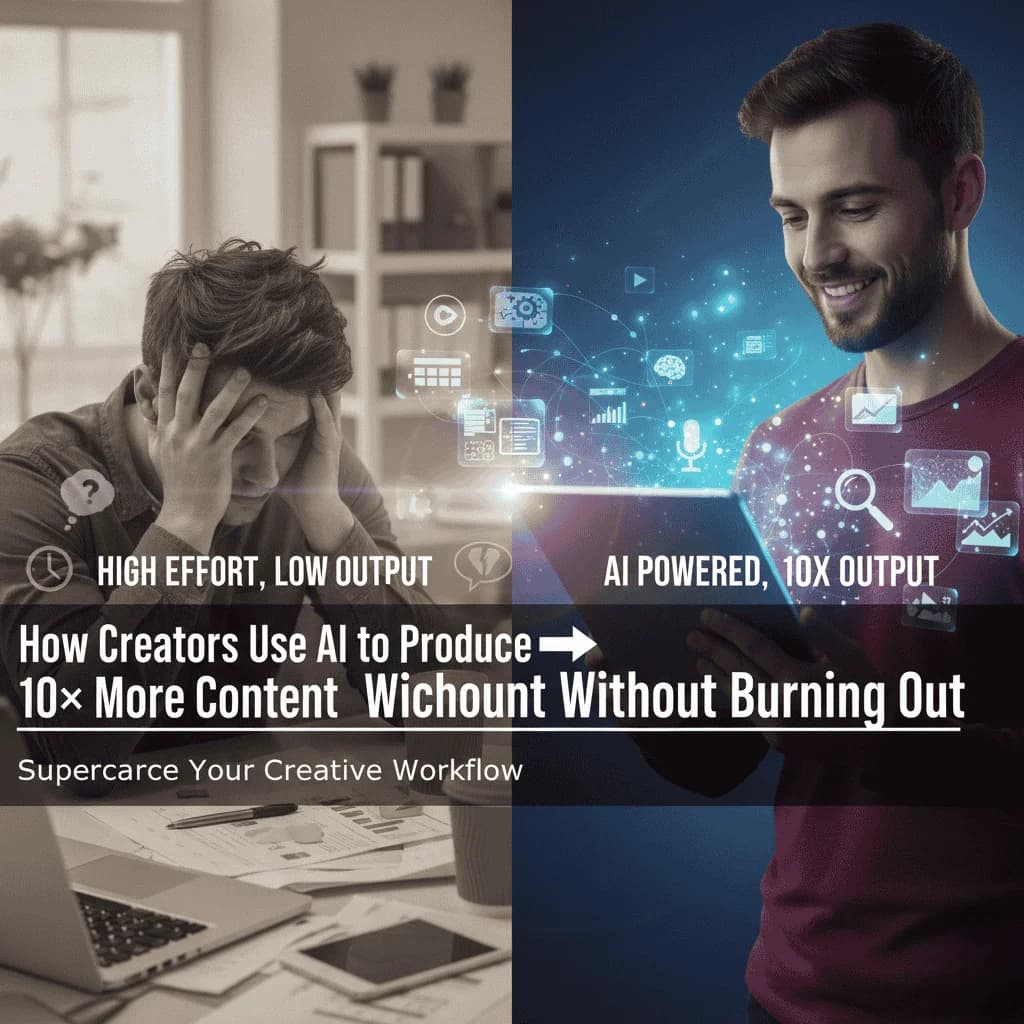
For years, “consistency” has been the unspoken tax of the creator economy. Post every day. Stay visible. Keep up with trends. Be everywhere at once. The result has been predictable: creators produce more content than ever, yet feel more exhausted, anxious, and creatively drained.
In 2026, something has shifted. The most successful creators are no longer working harder. They are working differently. Instead of treating content creation as a grind, they are using AI to remove friction, compress workflows, and protect their creative energy. The goal is not to replace creativity, but to preserve it.
This article looks at how creators across platforms are using AI to scale output—sometimes by an order of magnitude—without sacrificing quality or burning out in the process.
The Burnout Problem No One Likes to Admit
Creator burnout isn’t about laziness or lack of discipline. It’s about cognitive overload. Modern creators are expected to ideate, write, design, edit, publish, analyze, and repeat—often solo. Every piece of content carries invisible labor: decision-making, context switching, and emotional investment.
Platforms reward volume, but the human brain does not. When creators spend most of their energy on repetitive tasks—editing thumbnails, resizing assets, rewriting captions—there is little left for originality. Burnout follows, not because creators stop caring, but because caring becomes unsustainable.
AI entered this landscape not as a creative shortcut, but as a pressure release.
How AI Changed the Creator Workflow (Quietly)
Early AI tools promised “instant content.” Many creators tried them, dismissed the results as generic, and moved on. What changed was not the promise, but the application.
By 2026, creators no longer ask AI to “create for them.” They ask AI to prepare, assist, and extend. This shift—from replacement to augmentation—is the foundation of sustainable scale.
Instead of starting from a blank page, creators start from intent. AI handles the mechanical parts. Humans handle taste, voice, and judgment.
Idea Generation Without Creative Exhaustion
One of the most draining parts of content creation is not execution—it’s ideation. Coming up with ideas every day creates decision fatigue long before anything is published.
Creators now use AI as an ideation partner rather than an author. They generate topic clusters, alternative angles, hooks, and outlines. The creator still chooses what resonates. The difference is that choice replaces struggle.
This approach turns ideation into curation. Instead of forcing inspiration, creators react to options. The mental load drops dramatically.
Writing Faster Without Losing Voice
Writing is deeply personal, which is why many creators resist AI in this area. What has changed is how AI is used. Instead of generating final drafts, AI is used to structure thoughts, expand bullet points, or rewrite sections for clarity.
Creators often write one strong paragraph and let AI adapt it across formats—long-form posts, short captions, email intros—while preserving tone. Editing becomes refinement rather than reinvention.
The voice stays human. The speed increases.
Visual Content at Scale Without Endless Editing
Visual production has historically been one of the biggest burnout drivers. Editing photos, creating thumbnails, resizing assets, and producing variations can consume hours per post.
AI-powered editing and enhancement models now handle much of this invisible labor. Creators upload a base image and generate multiple polished versions suited for different platforms. Background cleanup, lighting correction, and stylistic adjustments happen quickly and consistently.
Platforms like Aspire AI fit naturally into this workflow by focusing on outcome-driven editing rather than tool complexity. Creators move from idea to publishable visual without getting stuck in technical details.
The result is not just more content, but more reusable content.
Turning One Asset Into Many
One of the most powerful ways creators scale without burnout is by extending a single idea across multiple formats. A long-form post becomes short clips. A photo becomes a subtle motion. A single concept becomes a week of content.
AI accelerates this process by handling transformation. Image-to-video tools create motion from stills. Text is adapted to different platform norms. Variations are generated quickly, allowing creators to test without overcommitting.
This shift changes the unit of work. Creators no longer think in posts. They think in content systems.
Automation That Doesn’t Kill Creativity
Automation has a bad reputation among creators because it’s often associated with spam and low-effort output. The difference in 2026 is intent.
Creators automate logistics, not expression. Scheduling, formatting, resizing, exporting, and versioning are automated. Decisions about what to say, why it matters, and when it feels right remain human.
By removing low-value tasks, automation protects creative energy instead of diluting it.
Data as Feedback, Not Pressure
Analytics used to be another source of burnout. Constantly checking numbers can turn creation into performance anxiety. AI has reframed analytics as feedback rather than judgment.
Creators now use AI to summarize performance trends, highlight what worked, and suggest adjustments—without forcing them to interpret raw dashboards. The emotional weight of metrics decreases, while insight increases.
This helps creators make informed decisions without obsessing over every fluctuation.
Why This Leads to 10× Output (Without 10× Effort)
The “10×” effect doesn’t come from working faster every hour. It comes from eliminating waste. When creators stop rewriting the same caption, re-editing the same image, or reinventing the same idea, output multiplies naturally.
AI compresses workflows. What used to take days now takes hours. What used to require multiple tools now happens in one place. The creator’s role shifts from operator to director.
That shift is what makes scale sustainable.
The Human Element Still Matters Most
It’s important to be clear: AI does not make creators replaceable. It makes generic creation replaceable. Audiences still respond to perspective, authenticity, and intent.
The creators thriving in 2026 are those who use AI to protect their humanity—not erase it. They set boundaries, choose where AI helps, and keep creative judgment firmly in human hands.
Burnout decreases not because work disappears, but because work becomes meaningful again.
Final Perspective
AI did not solve creator burnout by producing more content. It solved it by removing the parts of content creation that drain energy without adding value. When creators stop spending their best hours on mechanical tasks, they can create more—and feel better doing it.
In 2026, the most productive creators are not the most disciplined or the most automated. They are the most intentional. AI is simply the tool that lets that intention scale.
The future of creation is not about doing everything faster. It’s about doing the right things—and letting AI handle the rest.