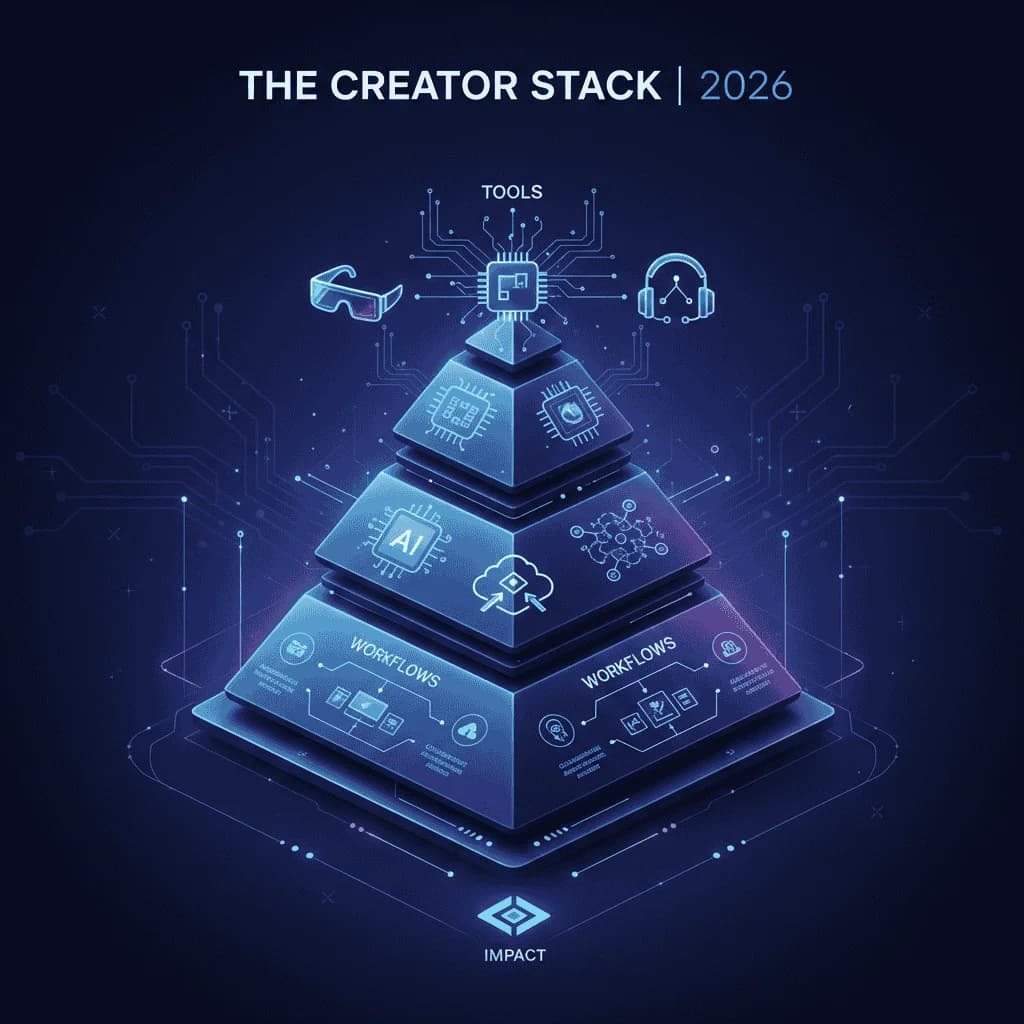
In the early days of the creator economy, success often came down to tools. The right editing app, the right camera, the right platform could make the difference between growth and obscurity. By 2026, that mindset is outdated.
Creators today have access to more tools than ever, yet many feel more overwhelmed, slower, and less fulfilled. The problem is no longer a lack of capability—it is stack complexity. Too many tools, overlapping features, and fragmented workflows drain creative energy instead of amplifying it.
The creators who thrive in 2026 are not the ones using the most tools. They are the ones using the right stack, built around intent, models, and repeatable workflows rather than apps and features.
This article breaks down what the modern creator stack actually looks like in 2026, which layers matter, and how creators are simplifying their workflows without sacrificing output or quality.
From Tool Obsession to Workflow Thinking
For years, creators built stacks by collecting apps. One tool for writing, another for images, another for video, another for scheduling. Each new problem meant adding another subscription.
AI changed this dynamic. When intelligence moved into the core of creative tools, the value shifted away from interfaces and toward underlying models and orchestration. The question became less “Which app should I use?” and more “What part of my workflow needs intelligence?”
This shift is subtle but profound. Modern creator stacks are no longer app-centric. They are workflow-centric.
Layer One: Intent and Direction (The Human Layer)
Every effective creator stack starts with something no tool can provide: intent.
Intent defines:
- Who the content is for
- Why it exists
- What it should change or communicate
In 2026, creators who skip this step suffer the most. AI can generate endlessly, but without direction, it produces noise. High-performing creators spend more time clarifying ideas and less time executing mechanics.
This layer is intentionally tool-free. It lives in thinking, outlining, and decision-making. Everything else in the stack exists to support it.
Layer Two: Models, Not Apps
One of the most important shifts in 2026 is that creators are increasingly model-aware, even if they don’t interact with models directly.
AI image generation, editing, writing, and video tools are powered by underlying models—diffusion models, language models, multimodal systems. These models define realism, creativity, speed, and consistency far more than the interface on top of them.
For example, large language models developed by organizations like OpenAI underpin many writing, summarization, and ideation workflows across platforms.
Similarly, image and video tools often rely on shared diffusion or generative architectures, even when branded differently. Understanding this helps creators focus on capabilities rather than brand names.
The practical takeaway is simple: creators benefit more from tools that abstract models intelligently than from tools that expose endless controls.
Layer Three: Creation and Editing Intelligence
This is where AI does its most visible work. In 2026, creators rely on AI not to replace creativity, but to remove friction.
Common tasks handled here include:
- Drafting and restructuring text
- Enhancing and retouching visuals
- Generating variations and adaptations
- Converting formats (image to video, long-form to short-form)
The key distinction is that creation and editing are no longer separate phases. AI blurs the line by enabling rapid iteration. A draft becomes a version, a version becomes a variant, and a variant becomes a final output with minimal overhead.
Platforms that emphasize outcome-driven workflows rather than raw generation fit naturally into this layer. Aspire AI reflects this approach by focusing on helping creators move from idea to polished visual without forcing them through fragmented tools.
Layer Four: Extension and Repurposing
One of the biggest changes in creator workflows is how content is reused. In 2026, a single idea rarely exists in one format.
Creators routinely extend:
- Articles into summaries and social posts
- Images into subtle motion or short video
- Long videos into clips and highlights
AI makes this practical by handling transformation at scale. Instead of recreating content manually, creators use AI to adapt strong ideas across platforms while maintaining coherence.
This layer is where creators unlock “10× output” without “10× effort.” The content doesn’t multiply because of speed—it multiplies because reuse becomes intentional.
Layer Five: Distribution and Feedback
Distribution used to be manual and stressful. Posting schedules, analytics dashboards, and performance tracking added cognitive load to already full workflows.
In 2026, AI reframes distribution as feedback rather than pressure. Instead of obsessing over metrics, creators use AI-assisted summaries to understand trends: what resonated, what didn’t, and what to try next.
Search engines like Google increasingly reward consistency, clarity, and topical depth rather than raw volume.
This means distribution strategies favor fewer strong ideas amplified well, rather than constant output.
What the Modern Creator Stack Does Not Include
Just as important as what belongs in the stack is what no longer does.
High-performing creators are actively removing:
- Redundant tools with overlapping features
- Manual resizing, exporting, and formatting steps
- Tools that require constant context switching
- Features that add control but not value
The modern stack is smaller, quieter, and more intentional. Complexity is treated as a liability, not a badge of professionalism.
Why Fewer Tools Lead to Better Work
Creativity thrives under constraints. When creators reduce tool sprawl, they reduce decision fatigue. Less time choosing how to create means more time deciding what to create.
AI enables this minimalism by consolidating capabilities that once required separate tools. Writing, editing, enhancement, and transformation increasingly live in unified environments.
The result is not just higher output, but higher satisfaction.
The Creator Stack as a System, Not a Setup
The most important mindset shift in 2026 is viewing the creator stack as a system rather than a setup.
A setup is static. A system evolves.
Creators regularly revisit their workflows, remove friction, and adjust tools as needs change. They treat AI as infrastructure, not novelty. They invest in learning how systems work rather than memorizing features.
This adaptability is what keeps them relevant as tools and platforms continue to change.
Final Perspective
The creator stack in 2026 is not defined by tools, subscriptions, or features. It is defined by clarity, leverage, and flow.
Creators who succeed are those who:
- Lead with intent
- Choose intelligence over complexity
- Build workflows that scale without burnout
AI did not make creators obsolete. It made unfocused creation obsolete.
In a world where execution is cheap, what matters is direction. The creator stack that actually works is the one that protects creative judgment, amplifies strong ideas, and removes everything that gets in the way.